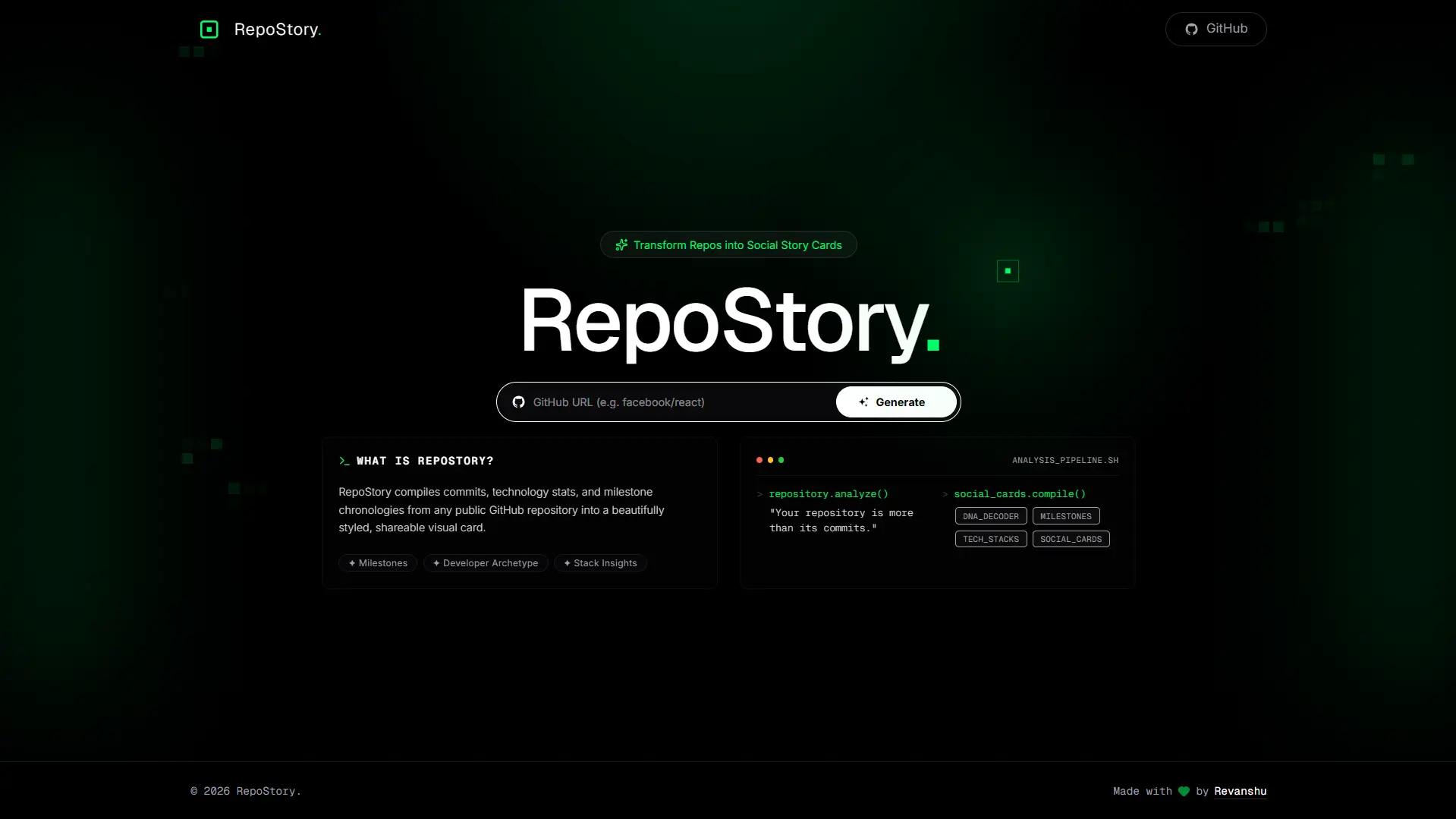
RepoStory
Turn your GitHub repository stats into beautiful developer story cards
RoleDesignDevelopment
ToolsGithub API, NextJS
Timeline: 2 DaysType: Personal
01
Problem
Developers build projects, push commits, and track progress through GitHub — but the raw data tells no story by itself.
- Commit histories are just chronological logs with no personality
- Language stats are bare percentages with no narrative context
- Release tags are version strings with no human meaning
- Sharing a GitHub link forces others to interpret raw data themselves — most simply won't
The gap: there's no easy way to look at a repository and immediately understand its character — who built it, how they worked, and what kind of project it really is.
02
Solution
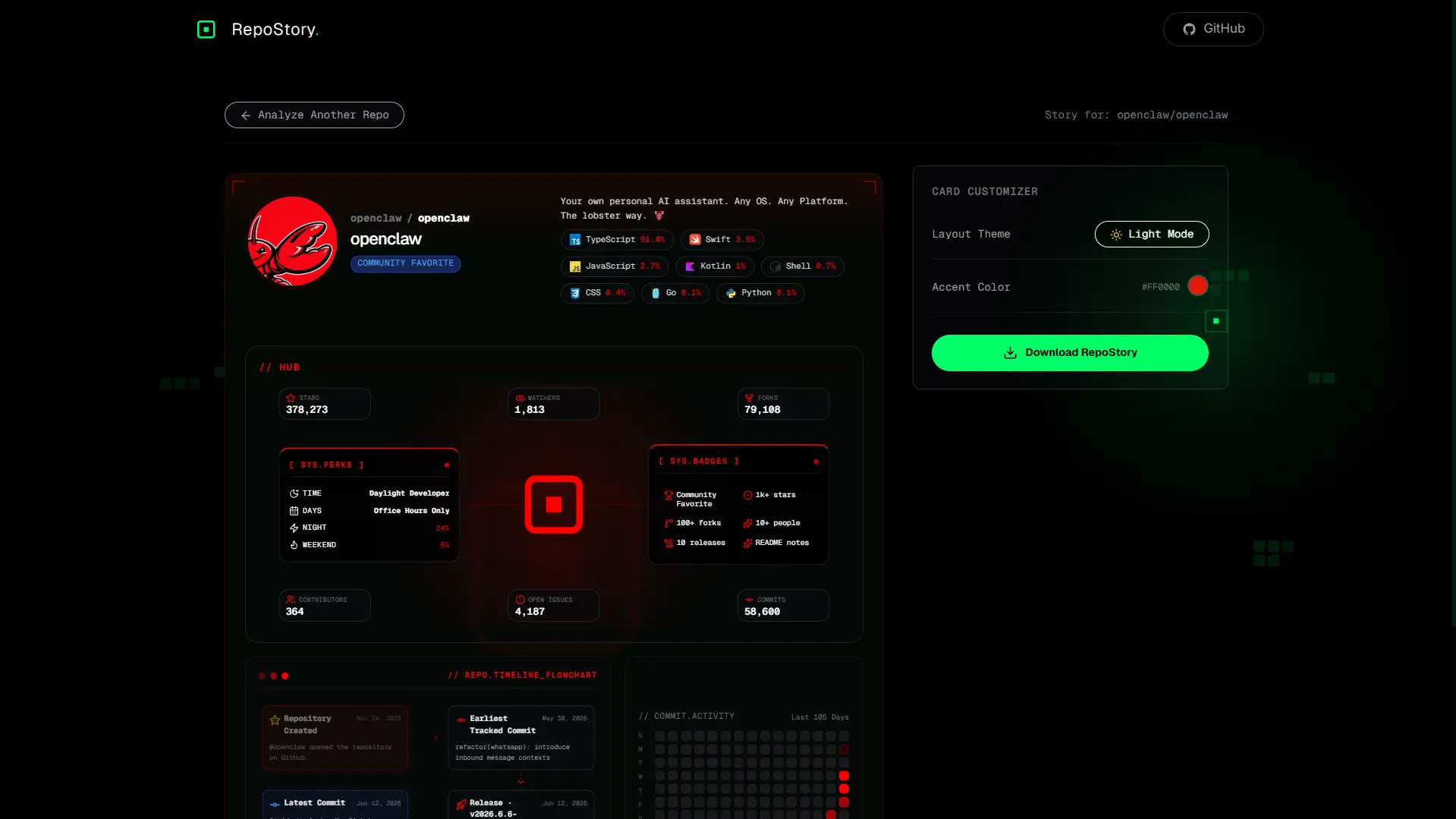
RepoStory transforms any public GitHub repository into a shareable visual story card in seconds.
How It Works
- Paste a repo URL → the app fetches commit data, language distributions, and release milestones via the GitHub API
- Assigns a developer archetype based on contributor count, age, and star metrics
- Classifies commit habits by analysing timestamps of when commits were made
- Optionally generates a developer narrative via Google Gemini
- Export as PNG or copy directly to clipboard
Developer Archetypes & Commit Habits
| Label | Type | Signal |
|---|---|---|
| Solo Builder | Archetype | Single contributor, consistent commits |
| Rising Star | Archetype | Fast growth in stars and forks |
| Legacy Giant | Archetype | Long-running, stable project age |
| Night Owl | Habit | Majority of commits after 10 PM |
| Weekend Warrior | Habit | Most commits on Saturday & Sunday |
Tech Stack
| Layer | Technology | Notes |
|---|---|---|
| Framework | Next.js + custom CSS | Deployed on Vercel |
| Data | GitHub REST API | 60 req/hr unauth · 5,000 req/hr with token |
| AI Layer | Gemini API | Optional — enhances without blocking |
03
Learnings
This project demonstrates how to build a meaningful product on top of a public API without a backend database.
Key Patterns
- Fetch → Classify → Render: structured API data → classification logic → polished visual output
- Archetype scoring is heuristic scoring — turning quantitative signals into qualitative labels people care about
- Next.js + Vercel = zero infrastructure, fast iteration, live URL from day one
What to Take Away
- Rate limit awareness is non-negotiable: always design for both unauthenticated and authenticated flows
- Environment variable management keeps API keys safe while keeping the codebase portable
- Making Gemini AI optional keeps the core product functional — AI enhances, but never blocks
- The data → classify → card pattern is reusable across dozens of other product ideas